Praxia for psychiatry
Discreet from the first minute, not from whenever somebody opens a settings screen. And the physical health monitoring that psychiatric medicines commit you to, held on its own clock.
A reminder that does not announce itself
An appointment reminder is read by whoever picks up the phone. For most specialties that is a minor matter. For a psychiatric practice it is the whole question.
So a psychiatric deployment of Praxia is created with discreet messaging on and online booking off. Not offered, not recommended in a setup guide — applied by the command that creates the practice, before anybody has had a chance to think about it. The doctor’s name and the visit type stay out of patient messages and out of diary labels, and nothing is bookable by a stranger with a link until the doctor decides otherwise.
Settings then shows which choices were made on your behalf and that each is yours to change. A promise about privacy that waits to be switched on is not a promise.
The monitoring the medicines commit you to
Prescribing lithium or an antipsychotic is a commitment to a set of tests, on intervals, for as long as the patient takes it. Those tests are the part that quietly lapses, because nothing about a calm follow-up appointment reminds anybody that a level is overdue.
- Lithium level
- Kidney and thyroid function
- Weight and waist
- HbA1c and lipid profile
- ECG
- Medication review
Six recalls, ready on the first day, each on your own interval. What has fallen due leads the morning screen, above the day’s appointments — because the appointments will happen whether or not anybody looks at them.
Scales stored as totals, and nothing more
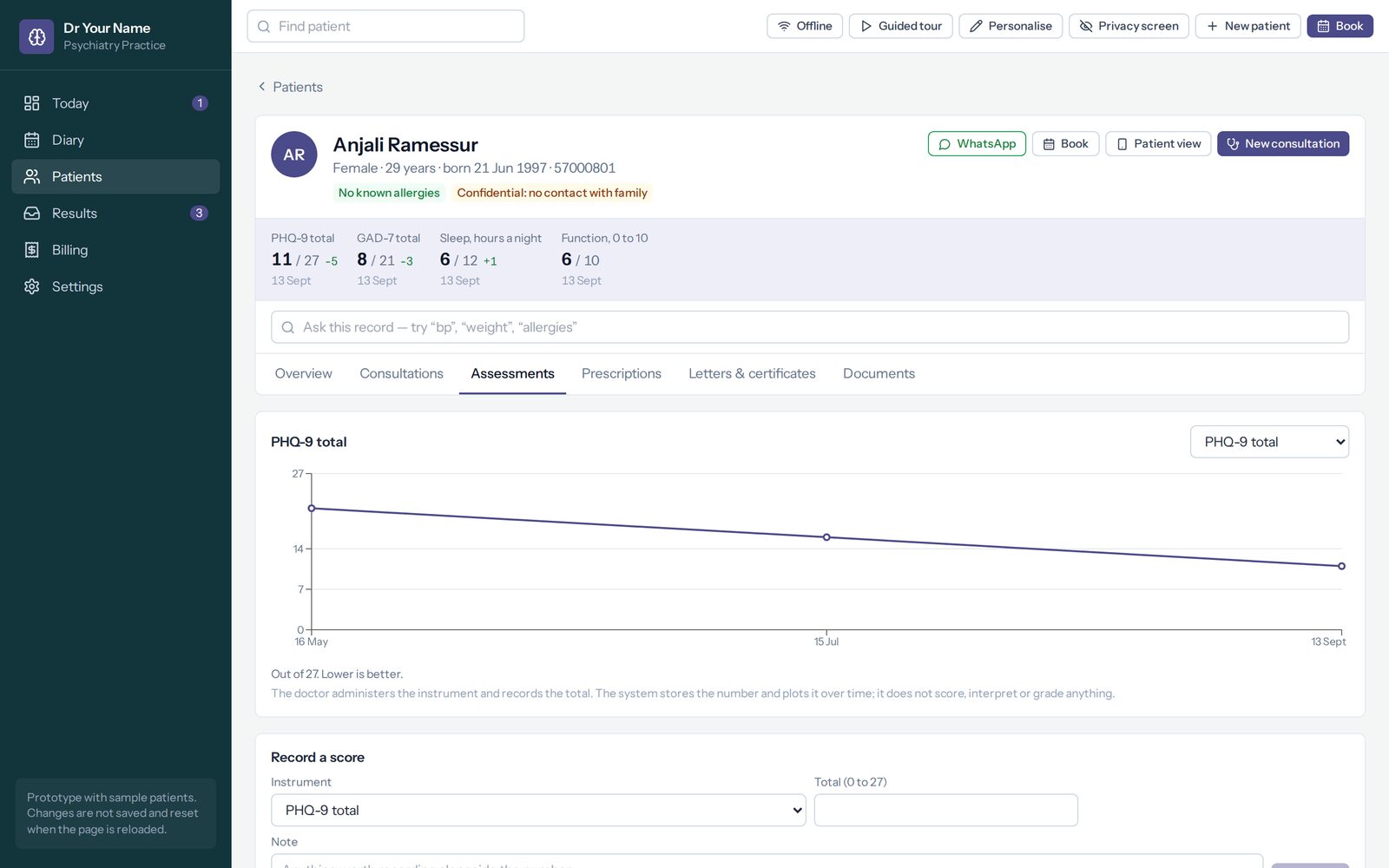
Praxia records a PHQ-9 or GAD-7 total, hours of sleep a night, and function out of ten, each with the date it was measured, and plots them over time.
It does not administer the questionnaire, does not add up the answers and does not say what the total means. Storing only the total is deliberate: a scale built into software starts being filled in by the software’s logic rather than by the patient, and a number that arrives without the conversation around it is worse than no number.
What Praxia will tell you is how the total moved since last time and whether that is the direction the scale itself calls better — PHQ-9 downwards, sleep upwards. That comes from the scale’s definition, not from a judgement about the patient.
Who can see the record
Every view of a patient’s record is written to an audit trail with who looked and when, and that trail cannot be edited from inside the application. A practice with a receptionist and a nurse is a practice where “who read this note” is a real question.
Appointments can be booked by your staff without the visit type being visible in the diary label, and a printed invoice can carry a fee without carrying a diagnosis.
The morning list, and the level that is overdue
A lithium level or an ECG that has fallen due leads the first screen — and the diary label beside it still does not say what the visit is for. The record opens on a phone, behind the same two-step sign-in.
What comes in the pack
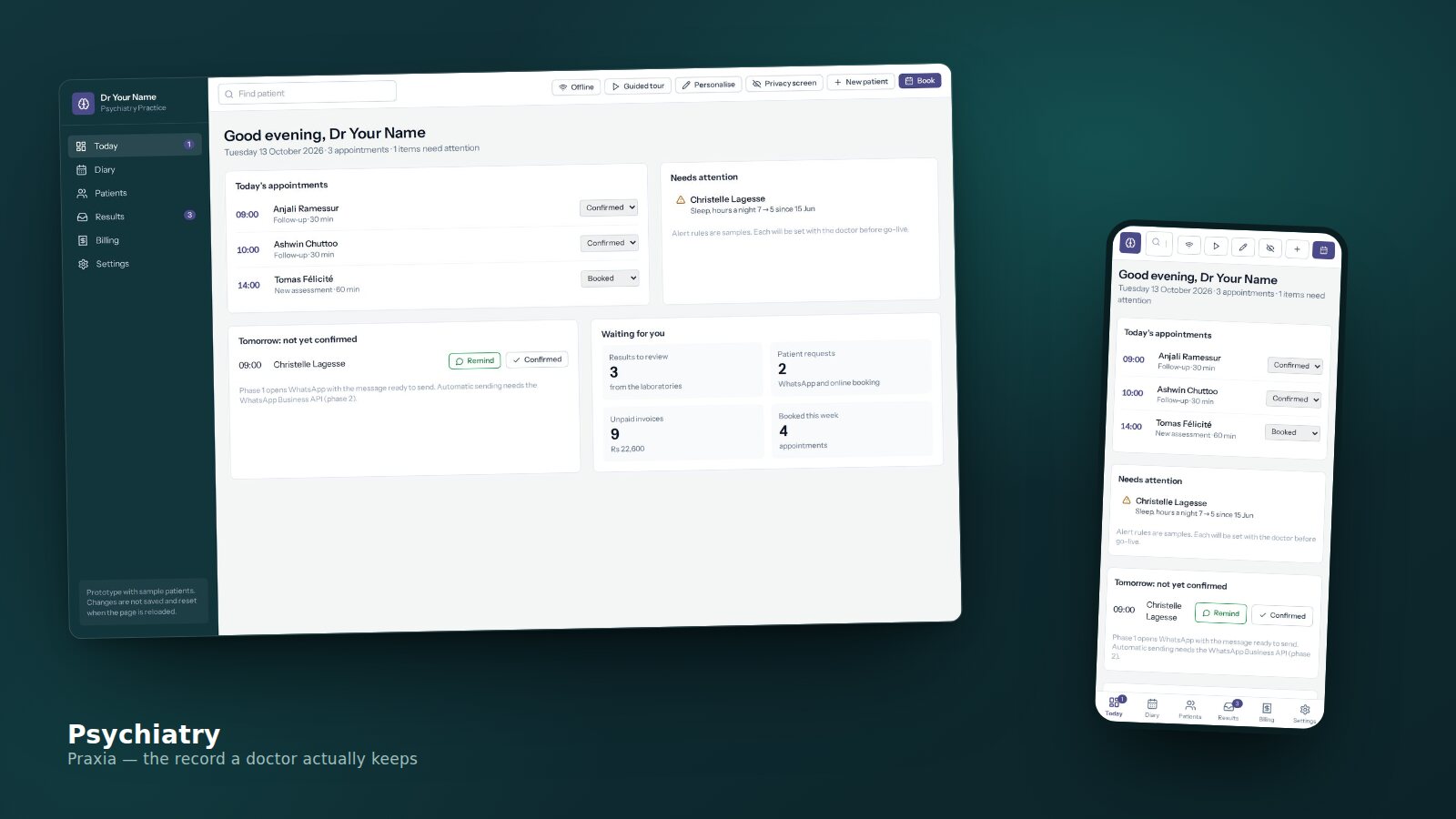
Created discreet, loaded before the first assessment, and every list yours to change afterwards.
- Three consultation forms — new psychiatric assessment, follow-up review, medication review
- 21 diagnoses, each with its ICD-10 code for insurance claims
- 16 medicines with the strengths and frequencies you prescribe
- Eight appointment types — a 90-minute new assessment through to brief reviews, therapy and family meetings
- 19 tests a psychiatric practice orders
- Six recalls for the monitoring above
Every one of those is a list you can change yourself, in the browser, without waiting for us. None of the appointment types is bookable online to begin with.
What it does not do
Worth saying plainly, because a psychiatric record that infers is a record that can be wrong about a person.
- It does not screen, score or triage. No questionnaire is administered by Praxia and no total is interpreted by it.
- It does not assess risk. There is no risk score anywhere in it, and there is not going to be one.
- It does not calculate doses. You prescribe; it prints what you prescribed.
An hour with your own practice in mind
The demo opens from a USB stick with no internet: a patient on lithium with the monitoring that goes with it, scores over six months, and a certificate that states no reason.