Praxia for general medicine
Long-term conditions are not one review a year. They are eight separate things with eight separate due dates, and Praxia holds each one on its own clock.
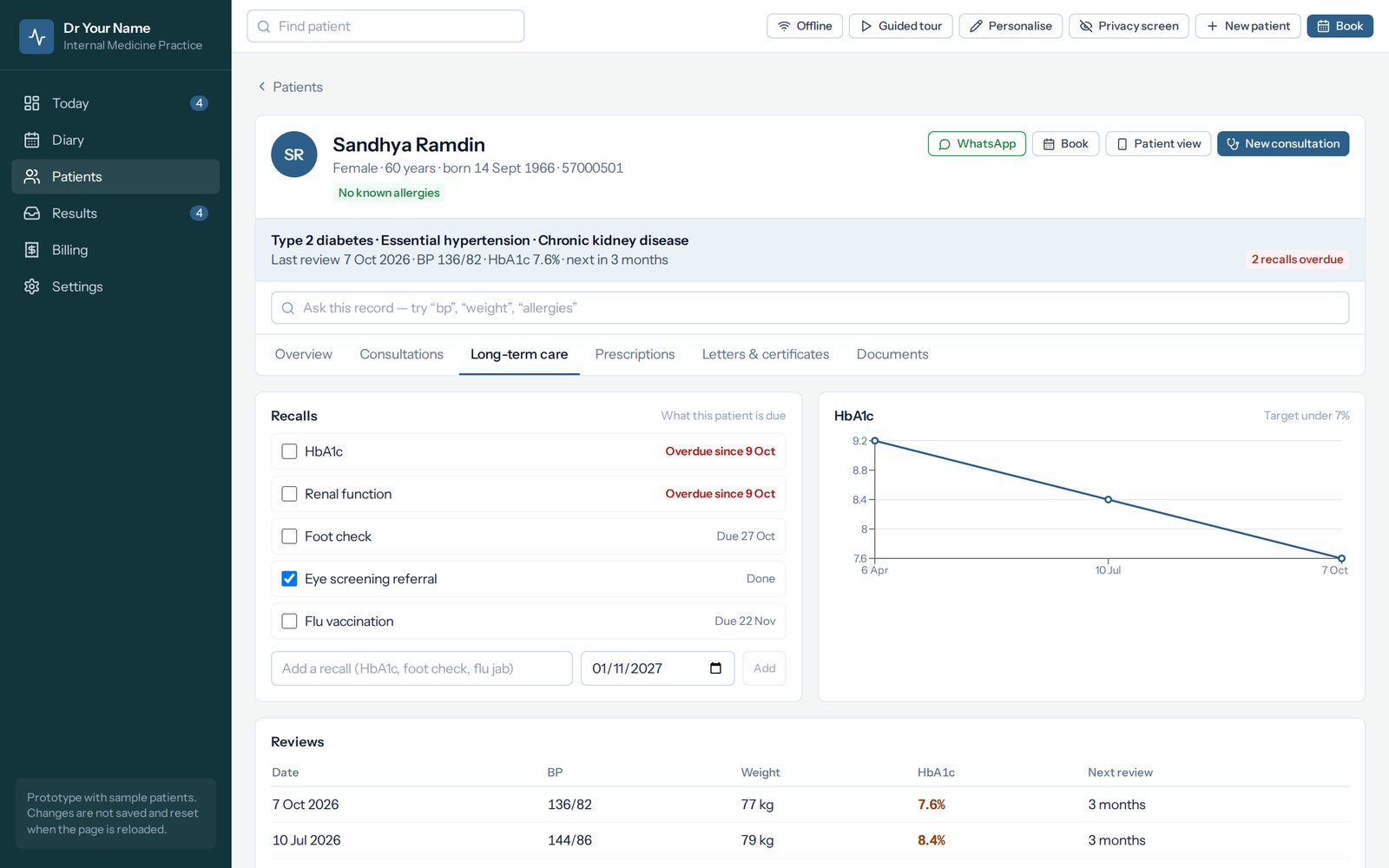
One number, four years, one line
A diabetic patient’s HbA1c is the most looked-at number in the practice and the hardest to see. Each result arrives on its own slip, months apart, and the question you actually want answered — is this better or worse than it was — needs six slips laid out in order.
The dashed line is the target recorded for this patient. Praxia draws it where the number says it goes and says nothing else about it: it does not call this good control, and it does not suggest a change. That remains yours.
Fourteen recalls, each with its own date
An annual review that covers everything covers nothing in particular. The foot check and the eye screening are not due at the same time as the lipids, and a single yearly appointment hides the one that has lapsed.
- HbA1c
- Kidney function and urine ACR
- Foot examination
- Eye screening
- Blood pressure
- Lipid profile
- Weight and waist
- Thyroid function
- Full blood count
- Spirometry
- Bone density
- Uric acid
- Medication review
- Influenza vaccination
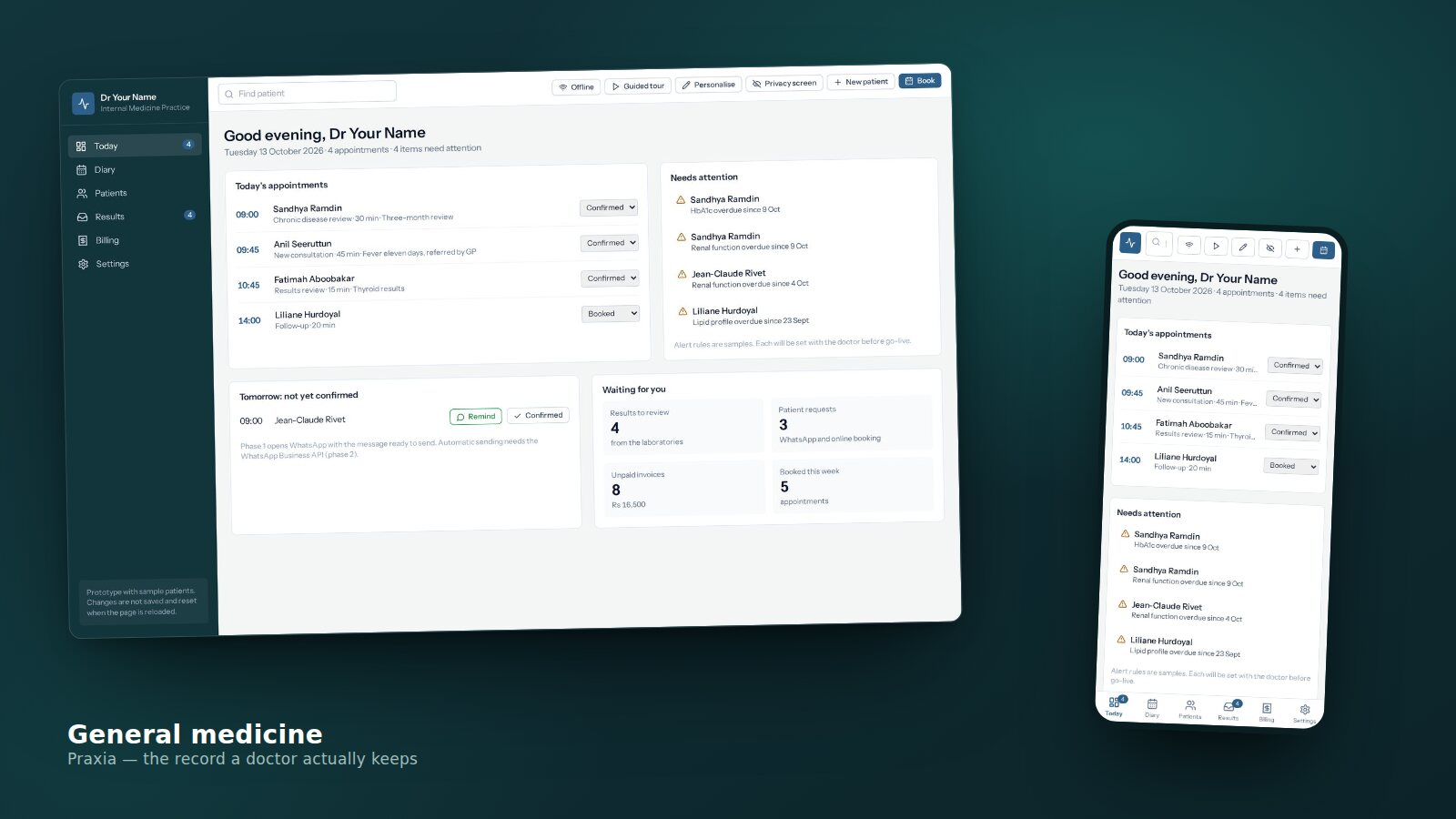
Each on your own interval, set once and changed in the browser. What has fallen due leads the morning screen, above the day’s appointments.
A result is not filed until it is acted on
The results review form records which results you looked at, the summary you gave the patient, and what you did about them — no change, medication changed, repeat in three or six months, referred, further imaging. The action is a field, not a sentence buried in a note.
That matters a year later, when the question is not what the result was but whether anybody did anything about it.
The chronic disease review form carries the measurements it turns on — pressure, weight, HbA1c, eGFR, LDL — as numbers rather than free text, so each of them can be plotted the way the chart above is plotted. It also records whether the patient is taking the medicine as prescribed, in their words: yes, mostly, often misses doses, stopped.
The morning list, and the check that lapsed
Fourteen recalls run on their own clocks, and the ones that have lapsed are the first thing on the screen. The record opens on a phone at a bedside.
What comes in the pack
Loaded before the first diabetic clinic, and every list yours to change afterwards.
- Three consultation forms — new medical consultation, chronic disease review, results review
- 32 diagnoses, each with its ICD-10 code for insurance claims
- 20 medicines with the strengths and frequencies you prescribe
- Nine appointment types — including second opinion, insurance medical and home visit — each with its length and fee
- 23 tests and scans a medical practice orders
- 14 recalls for what you call patients back for
Take off what you never pick and add what you reach for weekly. The appointment types already include the second opinion, the insurance medical and the home visit.
What it does not do
Worth saying plainly, because a long-term condition is where software starts to feel as though it is in charge.
- It does not interpret a result. It stores the number, plots it, and says only that it crossed a line you set.
- It does not manage the condition. The recalls are yours to set and yours to change; nothing is implied by a diagnosis you entered.
- It does not calculate a dose. You prescribe; it prints what you prescribed.
An hour with your own clinic in mind
The demo opens from a USB stick with no internet: a diabetic patient across two years of reviews, with the checks that are up to date and the ones that are not.