Praxia for ear, nose and throat
Thresholds for each ear, kept as numbers so this year can be compared with last year — and no average at all when a frequency was not tested.
Hearing kept as numbers, not as a filed printout
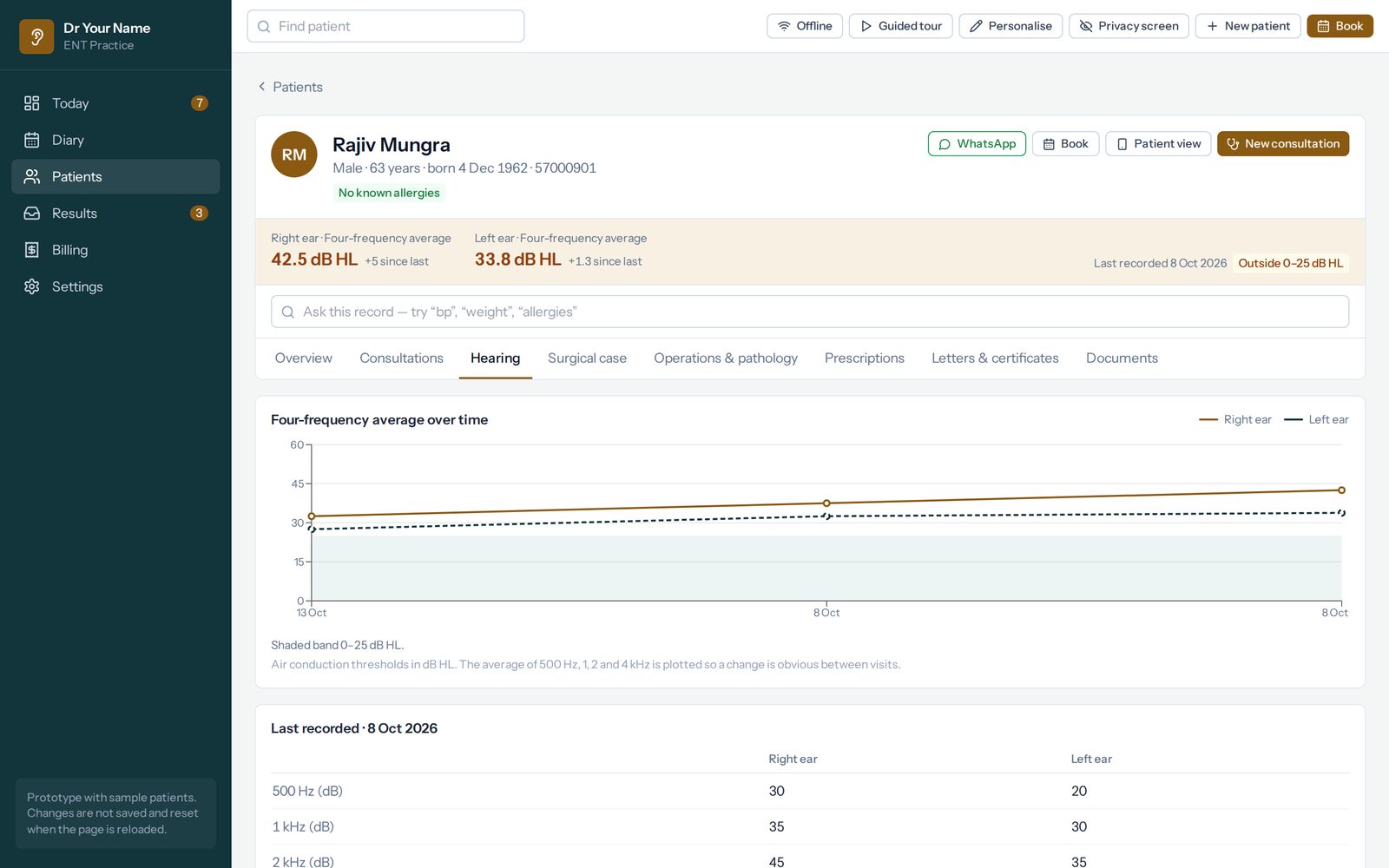
An audiogram scanned into a folder answers one question: what it looked like that day. Praxia records the thresholds themselves — 500 Hz, 1 kHz, 2 kHz, 4 kHz and 8 kHz for each ear, with the tympanogram type and the state of the eardrum — so four years of tests become four comparable rows.
The line is the average of 500 Hz, 1 kHz, 2 kHz and 4 kHz. Praxia states that the right ear is outside the 0 to 25 dB band recorded for this patient, and that it is up by ten or more since the previous test. Both of those are subtraction. Neither is a diagnosis, and nothing here is called presbyacusis.
Three frequencies do not make a four-frequency average
If one of the four frequencies is missing, Praxia records no average for that ear and leaves that visit off the chart, with a line saying why. It would be trivial to average the three that are there, and the number would be wrong in a way nobody could see afterwards — lower than the real average, by exactly as much as the missing frequency was the bad one.
A gap you can see is safer than a figure you cannot check.
Both ears in one record
The two sides are recorded together because they are always examined together and always read against each other. One row, two columns, in the order you examine them — and the same shape an ophthalmologist uses for two eyes, which is why an ENT practice and an eye practice share this part of Praxia and nothing else.
The nasal endoscopy form has its own fields, and the hearing review form is not a longer version of the new consultation. Grommets, hearing aids and nasal reviews each have a recall, so a child with grommets in place is called back because the record says so rather than because a parent telephones.
The morning list, and the grommets due a look
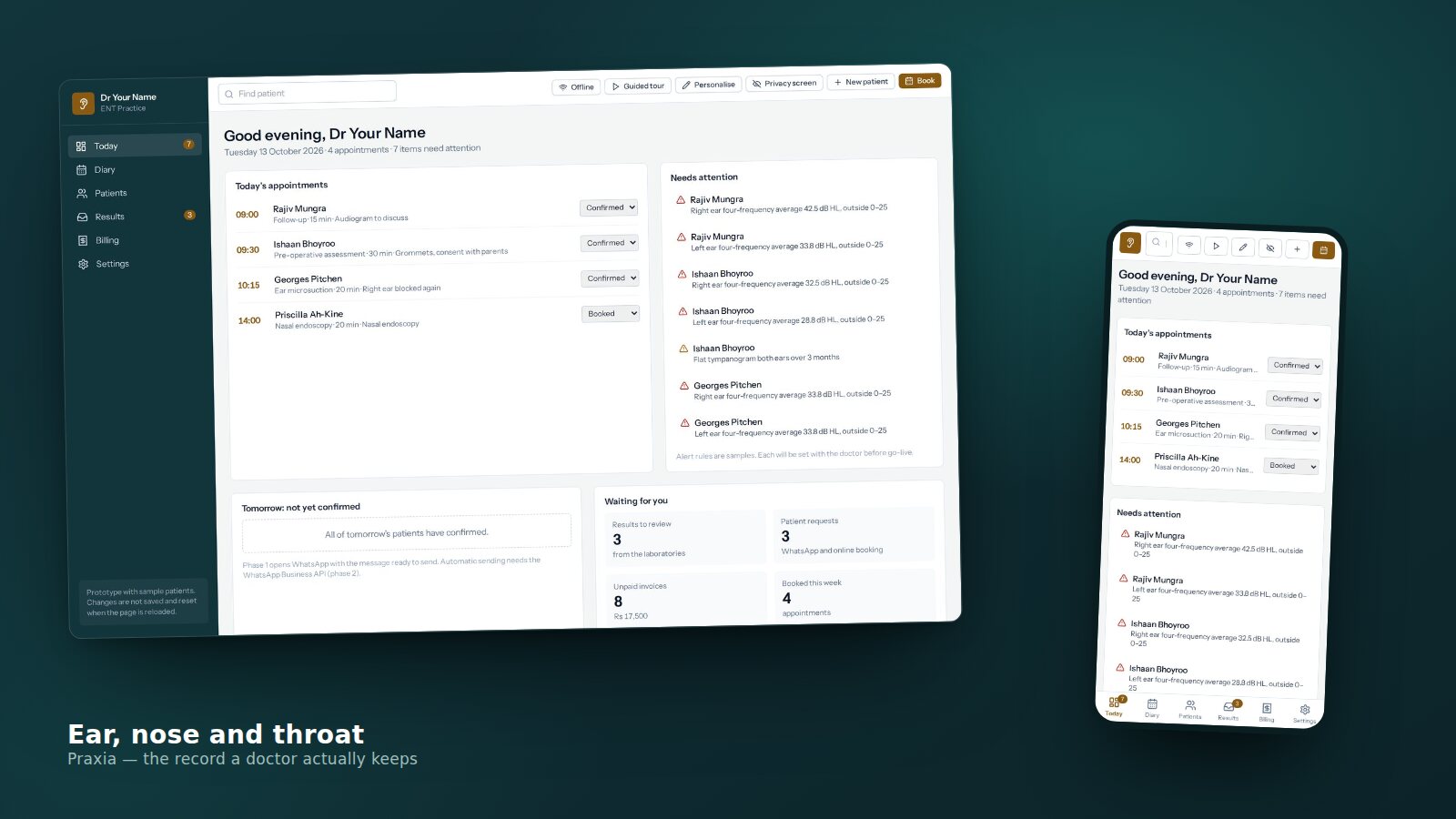
Hearing tests, hearing aid reviews and grommet reviews fall due on their own intervals and lead the first screen. The record opens on a phone between rooms.
What comes in the pack
Ready before the first clinic, and every list yours to change afterwards.
- Three consultation forms — new ENT consultation, hearing review, nasal endoscopy
- 25 diagnoses, each with its ICD-10 code for insurance claims
- 16 medicines with the strengths and frequencies you prescribe
- 10 appointment types, each with its length and its fee
- 24 tests and scans an ENT practice orders
- Four recalls — hearing test, hearing aid review, grommet review, nasal review
Each of those is a list you edit in the browser. The thresholds, and the band they are judged against, are yours.
What it does not do
Worth saying plainly, because this is the specialty where software is most tempted to average over a gap.
- It does not perform the audiometry. It records the thresholds your equipment measured.
- It does not classify the loss. Conductive or sensorineural, mild or severe — that is your reading, and it is recorded as yours.
- It does not average over missing data. Stated twice on purpose, because it is the one place this specialty tempts software to guess.
Try it against a hearing clinic
The demo opens from a USB stick with no internet: four years of thresholds for both ears, a tympanogram, and a child with grommets due a review.