Praxia for orthopaedics
Function scored and plotted, so recovery is something you can show a patient. The side recorded once and carried onto everything printed afterwards.
Recovery is a number the patient can see
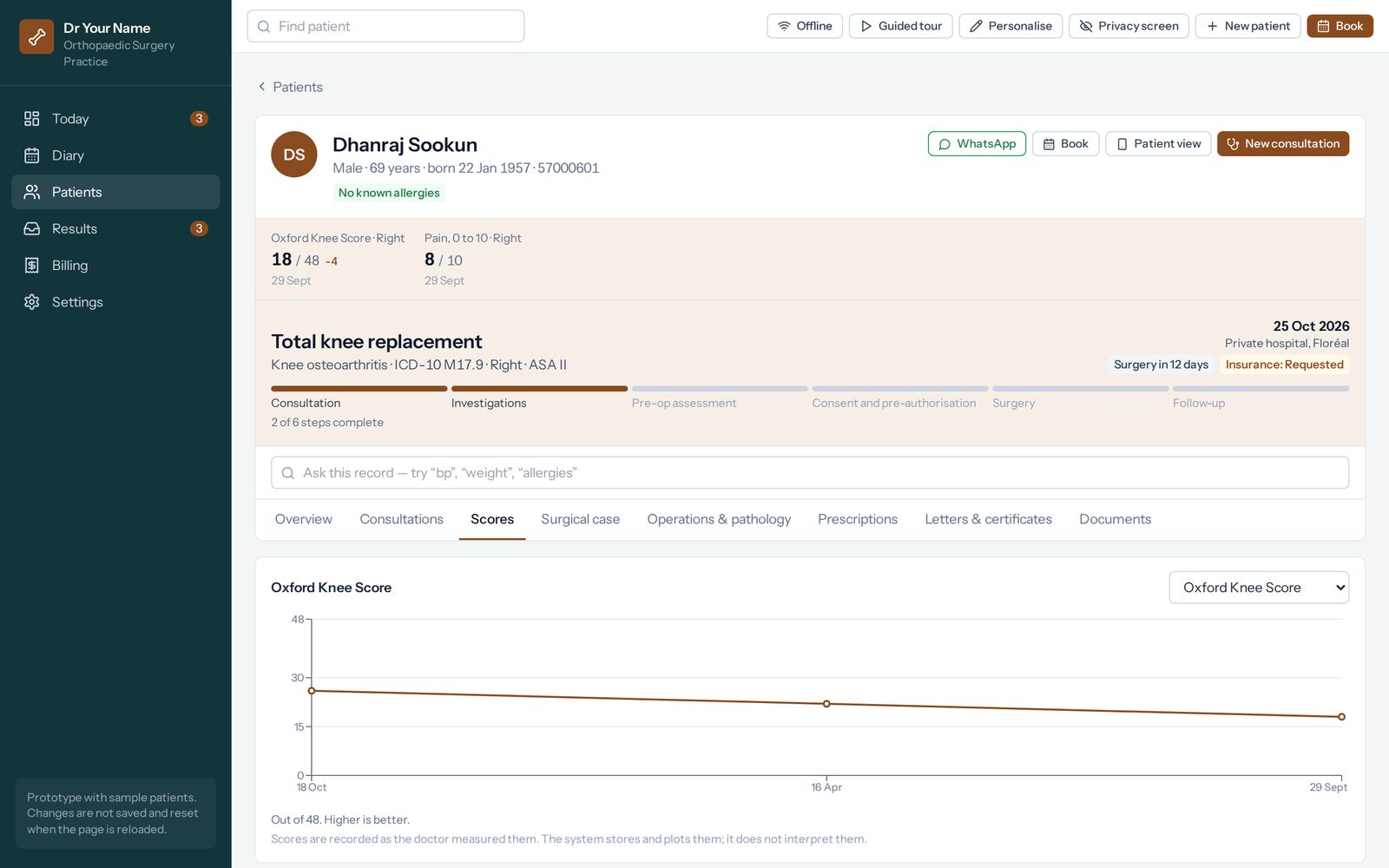
“Better than last time” is hard to argue with and hard to prove. A score taken before the operation and at each review afterwards turns it into something on the screen between you and the patient.
Praxia records the Oxford knee, hip and shoulder scores, and pain out of ten. You administer the questionnaire and enter the total; Praxia does not ask the questions, does not add up the answers and does not say what the number means. Storing only the total is the point — it keeps a clinical instrument a clinical instrument.
What it will tell you is which way the number moved and whether that is the direction the scale itself calls better. An Oxford score of 44 after 21 is an improvement because the Oxford score runs upwards; a pain score of 2 after 7 is an improvement because that scale runs the other way. That comes from the scale’s own definition, not from a judgement about the patient.
Each score carries the side it refers to, because a right knee and a left knee in the same patient are two different stories.
Side, written once
Side is the first field on the consultation form and on the surgical case, and it is carried onto the consent form, the operation note and the certificate. There is no retyping it, which is the only reliable way to stop it being typed differently somewhere.
A blank is not an answer. An upcoming operation with no side recorded is raised on the morning screen until somebody answers it, and the consent form will not print without it.
Fractures, reviewed on a form built for it
The fracture review form asks the five things a fracture clinic actually asks: weeks since injury, what it is immobilised in, what today’s radiographs show — position maintained, callus forming, united, slow union, position lost — and the plan.
Four reviews of the same fracture then read as four comparable entries rather than four paragraphs in four handwritings.
The joint injection form records the side, the joint, what was injected and what was aspirated, so the question “how many injections has this knee had, and when” has an answer.
The morning list, and the side nobody wrote down
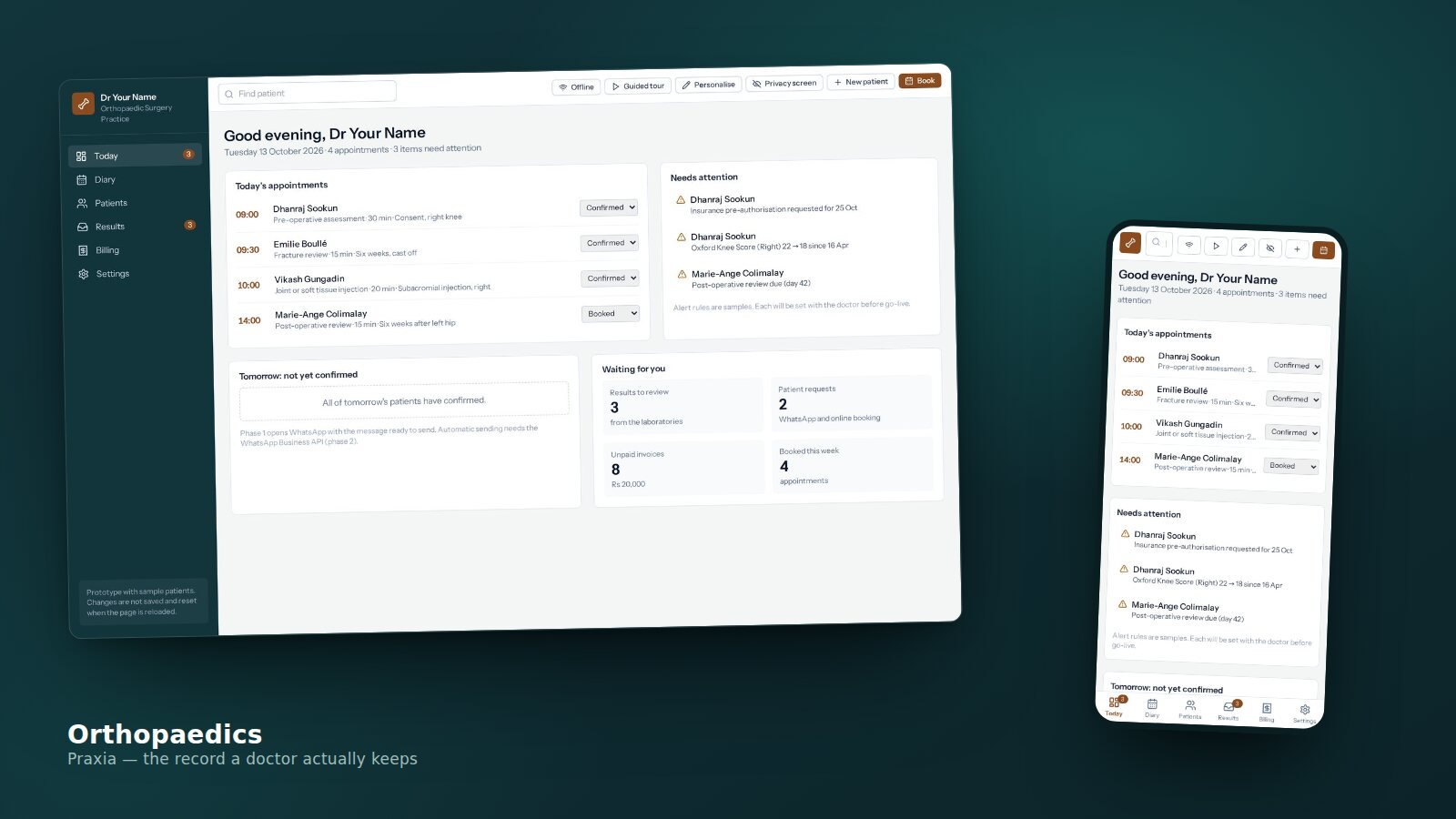
An operation booked with no side recorded is raised above the day’s clinic, and stays there until somebody answers it. The record opens on a phone in a fracture clinic.
What comes in the pack
Ready before the first fracture clinic, and every list yours to change afterwards.
- Three consultation forms — new orthopaedic consultation, fracture review, joint injection
- 28 diagnoses, each with its ICD-10 code for insurance claims
- 15 medicines with the strengths and frequencies you prescribe
- 10 appointment types — consultations, injections, plaster, aspiration, theatre lists — each with its length and fee
- 24 tests and scans an orthopaedic practice orders
- Four recalls — Oxford score, joint replacement review, bone density, vitamin D
Take off what you never pick and add what you reach for weekly. The appointment types already carry injections, plaster, aspiration and theatre lists.
What it does not do
Worth saying plainly, because a record that quietly fills in a blank is how a wrong side reaches a consent form.
- It does not score the questionnaire. You enter the total you measured; it stores and plots it.
- It does not read an X-ray. It records what you concluded from one.
- It does not plan an operation. No templating, no implant sizing — it is the record, not a workstation.
Try it against a fracture clinic
The demo opens from a USB stick with no internet: a knee replacement scored before and after, a fracture reviewed four times, and a consent form that refuses a blank side.