Praxia for general surgery
One case from the first consultation to the histology result: pre-authorisation, theatre date, consent, the operation, the specimen. Nothing waiting quietly in somebody’s head.
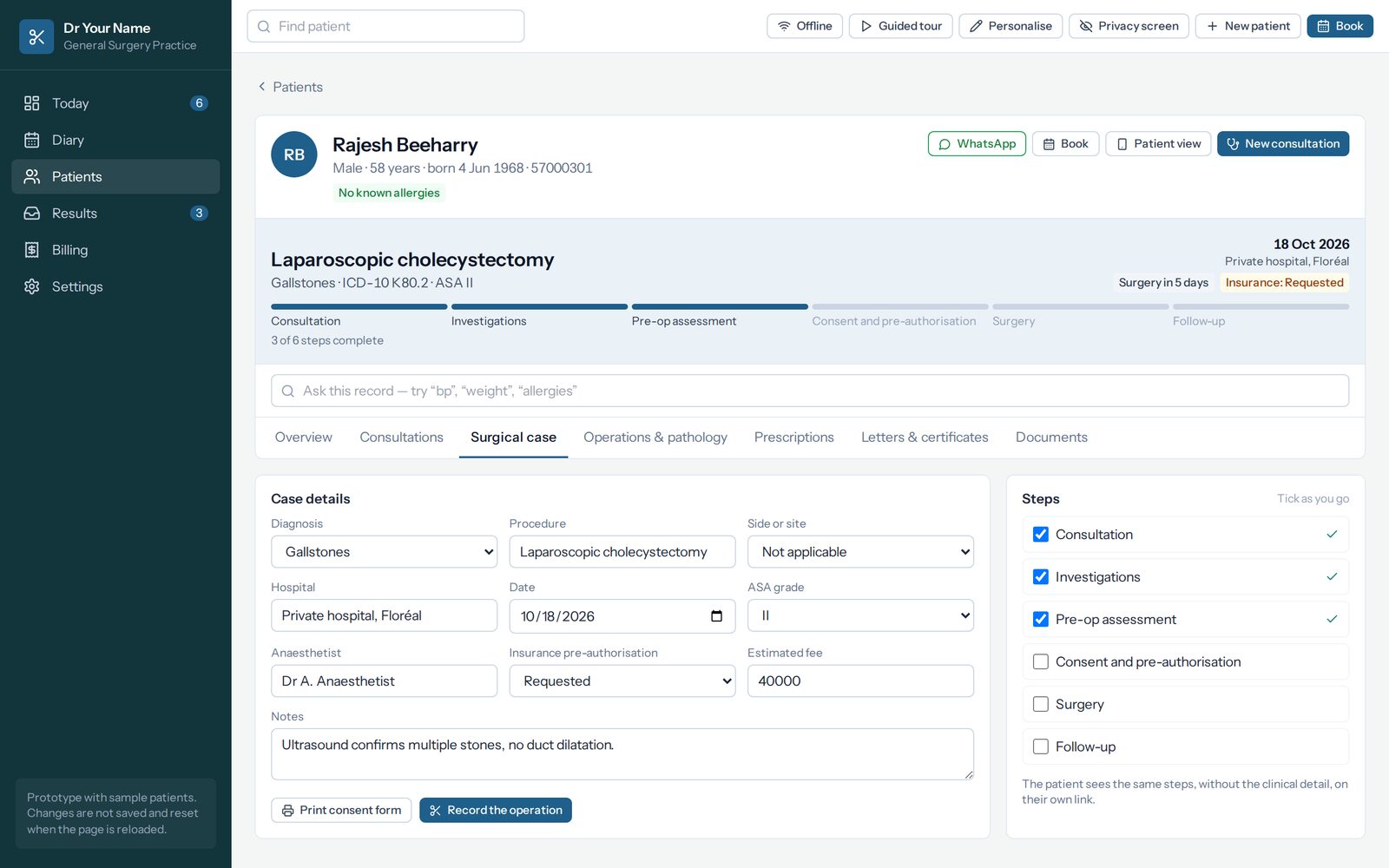
The case is the record, not the consultation
A surgical patient is not a series of unrelated visits. One hernia is a diagnosis, an insurer to be asked, a date, a consent conversation, an operation note, a specimen and a follow-up — and the dangerous part is always the step nobody is holding.
Praxia keeps the case as one record with six steps on it, and shows you which step it is on:
- Consultation
- Investigations
- Pre-operative assessment
- Consent
- Surgery
- Follow-up
Pre-authorisation sits on the case itself, as one of not required, to request, requested, approved or declined. A theatre date with an insurer never asked is a cancelled list and an angry patient, and it is exactly the kind of thing a diary cannot tell you.
The side, written once
Side is recorded on the case — right, left, bilateral, midline, or not applicable — and carried onto everything printed from it afterwards. A gastroscopy has no side, so not applicable is a choice the surgeon makes rather than a blank.
A blank is not an answer, and Praxia does not treat it as one. An upcoming operation with no side recorded is raised on the morning screen until somebody answers it, and the consent form will not print without it.
What was explained to the patient is kept in the surgeon’s own words and printed on the consent form as written. Praxia has no list of standard risks to tick, because a consent form built from a dropdown is a form the patient was not actually given.
A specimen nobody chased
Every specimen is a row on the case: what was sent, when, to which laboratory, and whether the report is back, discussed with the patient, or taken to the multidisciplinary meeting.
Praxia raises a specimen still pending after a week, and raises a report that has come back but has not yet been discussed with the patient. Those are the two places a surgical case goes quiet: waiting on a laboratory, and waiting on a phone call.
Neither of those is a clinical judgement. One is a date subtraction; the other is a field nobody has filled in.
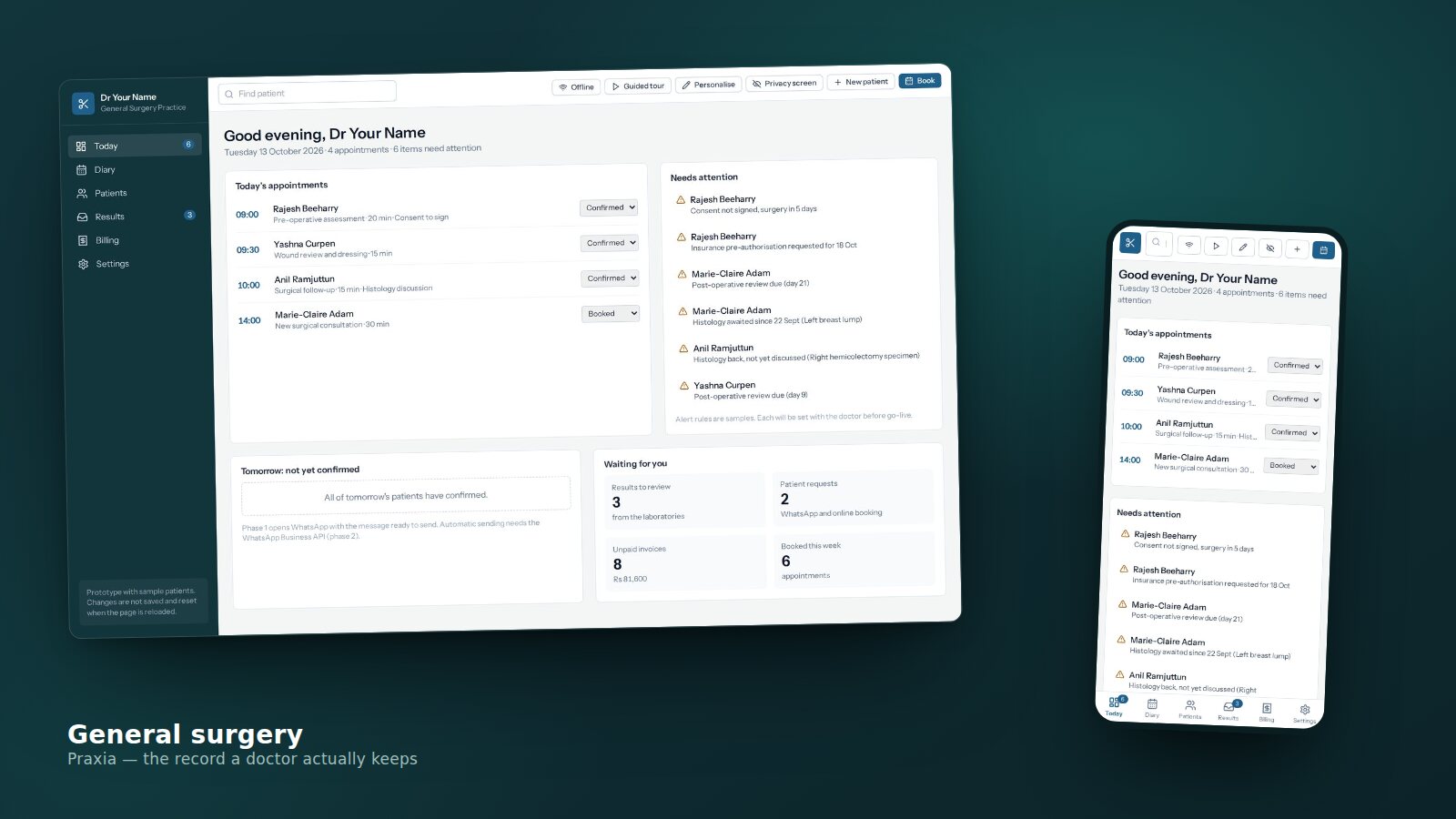
The morning list, and the specimen nobody chased
A specimen pending too long, and a report back but not yet discussed, are both on the first screen above the day’s clinic. The case opens on a phone in a hospital corridor.
What comes in the pack
Ready before the first theatre list, and every list yours to change afterwards.
- Three consultation forms — surgical consultation, pre-operative assessment, post-operative review
- 20 diagnoses, each with its ICD-10 code for insurance claims
- 11 medicines with the strengths and frequencies you prescribe
- 19 appointment types, consultations through to theatre lists, each with its length and fee
- 22 tests and scans a surgical practice orders
- Three recalls — post-operative review, colonoscopy surveillance, hernia review
Every one of those is a list you can change yourself, in the browser, without waiting for us. ASA grade, anaesthetic, anaesthetist, hospital and fee estimate are on the case so that a quote and a theatre booking come out of the record rather than out of a notebook.
What it does not do
Worth saying plainly, because a surgical record that overstates what it knows is a dangerous document.
- It does not write your consent form for you. It prints what you explained, in your words.
- It does not grade a patient’s fitness. You set the ASA grade; it records it.
- It is not a theatre management system. It holds your list and your cases, not a hospital’s.
Take it to a theatre list
The demo opens from a USB stick with no internet: a case from consultation to histology, a consent form, and a pre-authorisation still waiting on an insurer.